
PLUSnxt Briefings


PLUSnxt Briefing: What's New in Legal AI, Fall 2026
Four developments from this quarter with the most direct impact on your matters: RelativityOne becoming Relativity aiR, a federal court's first ruling on generative AI review, what Relativity Server matters are missing, and where matter data travels between AI tools.
There's a lot of AI noise in legal right now. New tools arrive every month, from eDiscovery platforms, research providers, and the model companies themselves. Familiar products are being renamed around AI, so a name you've seen in a dozen proposals may now describe something different. Court orders on AI are landing fast and can look like they point in different directions. Vendor claims about accuracy, cost, and security are hard to check from the outside.
Any one of those is easy to tune out. Together they're changing how matters get reviewed, defended, and managed, often before a legal team has decided to change anything. So we've pulled the four developments from this quarter that deserve your attention. For each one, we cover what changed and what it means in practice: how your documents get reviewed, whether that review holds up if it's challenged, and where your data ends up.
1. RelativityOne Is Now Relativity aiR, and AI Sits at the Center of the Platform
Relativity’s renamed platform and its expanded set of AI capabilities will start showing up by name in outside counsel proposals, ESI protocols, and vendor statements of work. Knowing what each capability does and what it produces makes those documents easier to evaluate, and it makes it easier to ask the right questions when one is proposed for your matter.
What Changed
On September 16, RelativityOne became Relativity aiR. Relativity aiR was previously the name for the company’s suite of agentic AI capabilities integrated into its extensible cloud platform, RelativityOne. The name unifies the platform and its AI capabilities and reflects AI’s central role in how legal teams do their most complex work. It’s the same platform under a new name (Relativity newsroom; LawSites, September 16), and the rename signals where Relativity is headed: AI is now the center of the platform rather than a set of add-ons.
Relativity’s president, Chris Brown, described the platform as both “the system of record for the industry’s most sensitive data and the system of action that reads it, reasons over it and turns it into work product with transparency, defensibility and governance.”
Capabilities and What Each Piece Produces
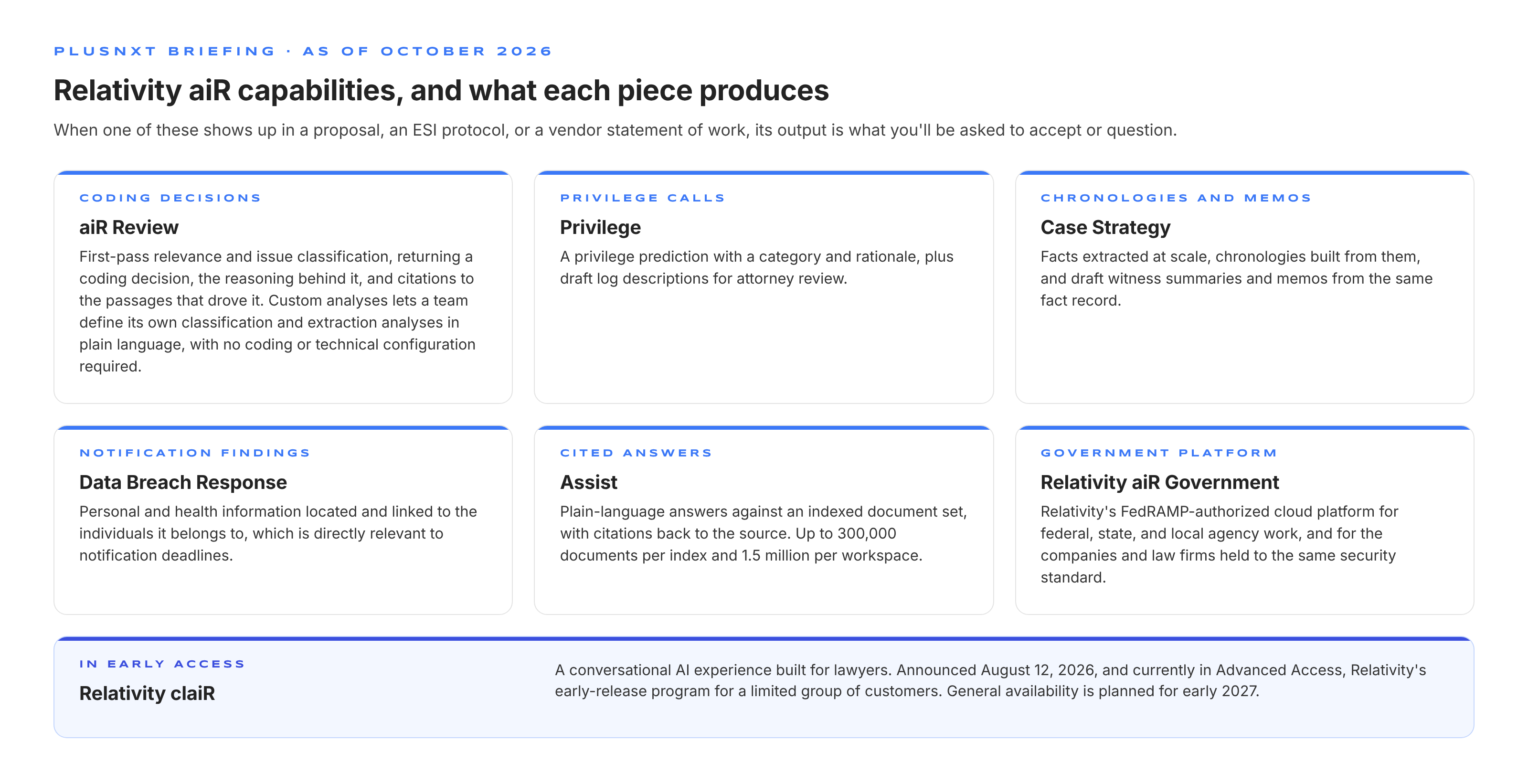
Here’s the current lineup with what each capability or solution produces, since the output is what you’ll be asked to accept or question when one of these shows up in a proposal or protocol.
- aiR Review: Handles first-pass relevance and issue classification, returning a coding decision, the reasoning behind it, and citations to the passages that drove it. Custom analyses in aiR Review, standard since the end of June, lets a team define its own classification and extraction analyses in plain language with no coding or technical configuration required (Relativity, June 16).
- Privilege: Predicts privilege with a category and rationale and drafts log descriptions for attorney review.
- Case Strategy: Extracts facts at scale, builds chronologies, and drafts witness summaries and memos from the same fact record.
- Data Breach Response: Locates personal and health information and links it to the individuals it belongs to, which is directly relevant to notification deadlines.
- Assist: Answers plain-language questions against an indexed document set with citations back to the source, at up to 300,000 documents per index and 1.5 million per workspace.
- Relativity aiR Government: Relativity’s FedRAMP-authorized cloud platform, built for federal, state, and local agency work. It’s increasingly relevant to companies with government contracts, and to the law firms that represent them, because those companies are held to the same security standard.
- Relativity claiR: A conversational AI experience built for lawyers, announced August 12 and currently in Advanced Access, Relativity’s early-release program in which a limited group of customers uses a feature before it becomes generally available. General availability is planned for early 2027 (Relativity, August 12).
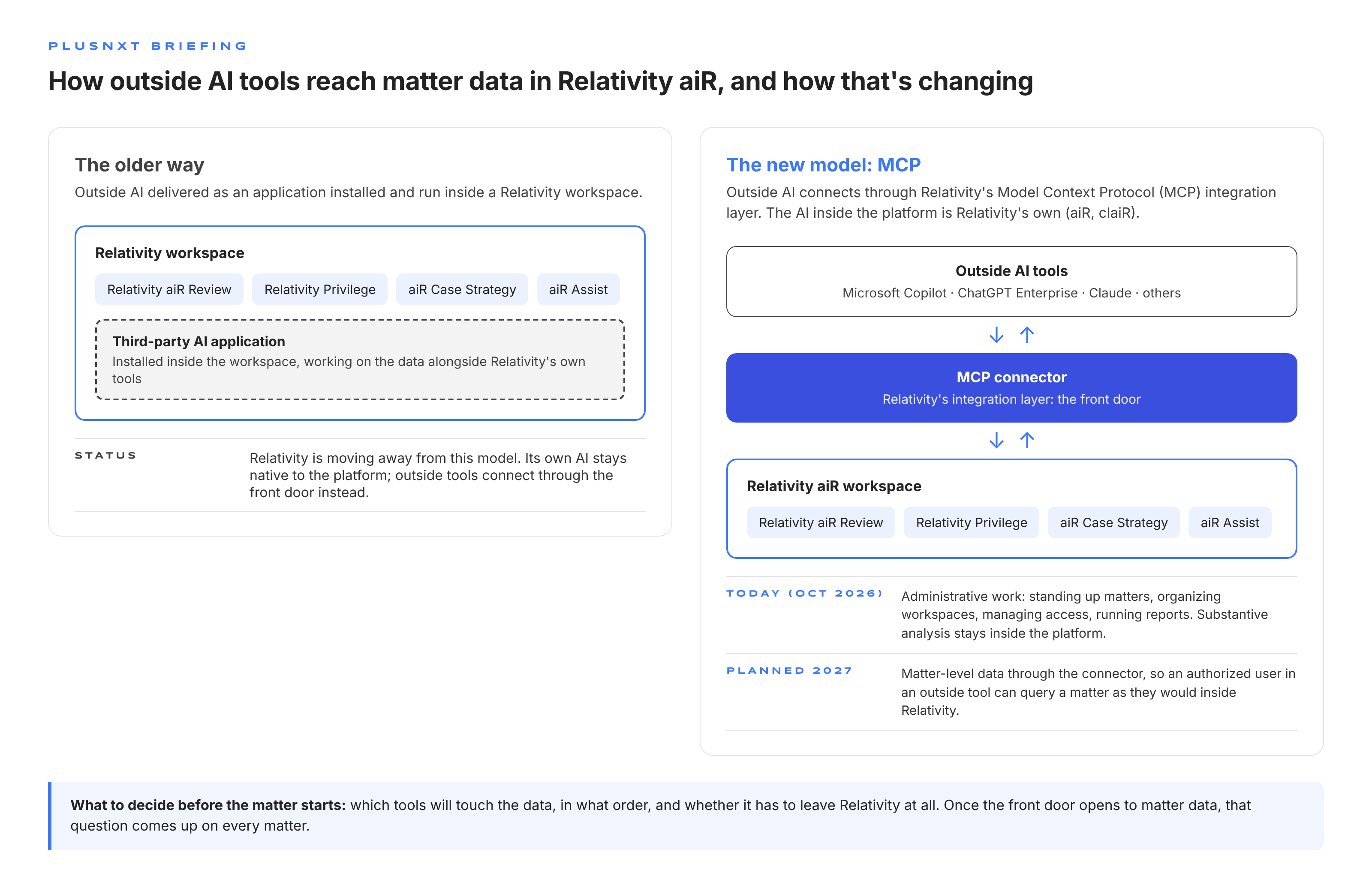
Separately, the platform now connects to outside AI tools through Model Context Protocol (MCP). MCP is an open standard that lets tools such as Microsoft Copilot, ChatGPT Enterprise, and Claude work with aiR through a controlled, permissioned integration instead of manual exports. That matters because it determines how those tools reach your matter data and what access controls apply when they do. Today the connections cover administrative work. Section 4 covers where that’s going.
2. Courts Have Accepted AI Review, Under the Rules You Already Know
You can comfortably use generative AI for first-pass review on your matters. In what commentators are calling the first federal ruling on generative AI review, the court applied the same standards courts have used for technology-assisted review (TAR) for more than a decade. Two things to carry into your next matter: get the validation terms into the ESI protocol before the first production, and keep a human review step in the workflow. Together, they make AI review defensible.
What the Court Decided
In Schulte v. LinkedIn Corp., No. 22-cv-00237-HSG (LB), 2026 WL 1905851 (N.D. Cal. July 1, 2026), LinkedIn used Relativity aiR to make final responsiveness calls on 204,444 documents, with search terms narrowing the set first and human review of samples from each responsiveness category as validation.
Plaintiffs asked for extra scrutiny: no culling, review of every custodian's full files, and production of error rates and other validation metrics. Magistrate Judge Laurel Beeler denied all of it (DLA Piper; ComplexDiscovery). The court treated the generative AI workflow as a form of TAR, applied the usual proportionality rules, and held that the size of a review alone doesn't entitle the other side to validation data unless it can point to a specific problem in the production.
What It Means on Your Matters
The expectations are the ones you already know from TAR, and human validation is part of them. LinkedIn's review held up because people checked samples from every category, and an AI pass with that step built in is what the court approved. The leverage sits at the front of the case: whatever either side wants disclosed about AI validation gets negotiated in the ESI protocol before the first production, because after it, the requesting party has to show a specific deficiency. Schulte is one magistrate's decision on one record and binds no other court, but it's the clearest signal yet.
A separate line of cases, about court filings rather than document review, points the same way. This year's sanctions decisions keep landing on lawyers who filed briefs with citations nobody verified. In Whiting v. City of Athens (6th Cir. March 2026), the Sixth Circuit sanctioned two attorneys whose briefs contained more than two dozen fake citations and misstatements of fact, ordering each to pay $15,000 in punitive sanctions on top of the other side's appellate fees (ABA Litigation News, 2026). The setting is different, but the principle is the same: courts are fine with AI in the workflow and unforgiving about output no one checked.
3. Relativity Server Matters Are Missing the AI, and the Clock Is Running
If any of your matters still run on Relativity Server, they’re already missing out. The review method the courts just accepted isn’t available on Server, and that’s true now, well ahead of the 2028 date. For those matters, the question is when they move and how.
What Server Matters Are Missing Today
Relativity Server no longer gets new features. Every aiR capability above is cloud-only, so the first-pass review the courts just accepted can't run on a Server matter, and the gap widens with each release (Relativity Server policy).
The Dates
Starting January 1, 2028, every new matter and workspace has to be hosted in Relativity aiR, with some limited customer and geographic exceptions and existing matters continuing to be supported in Relativity Server (LawSites, January 2025; Relativity Server support policy). Relativity’s CEO, Phil Saunders, confirmed the 2028 date in October and put it this way: “The policy is not to end the life of Server. The policy is to make sure that no net new matter goes to Server effective Jan. 1.” (LawSites, October 2).
4. The Tools Are Multiplying, and Matter Data Is Moving Between Them by Hand
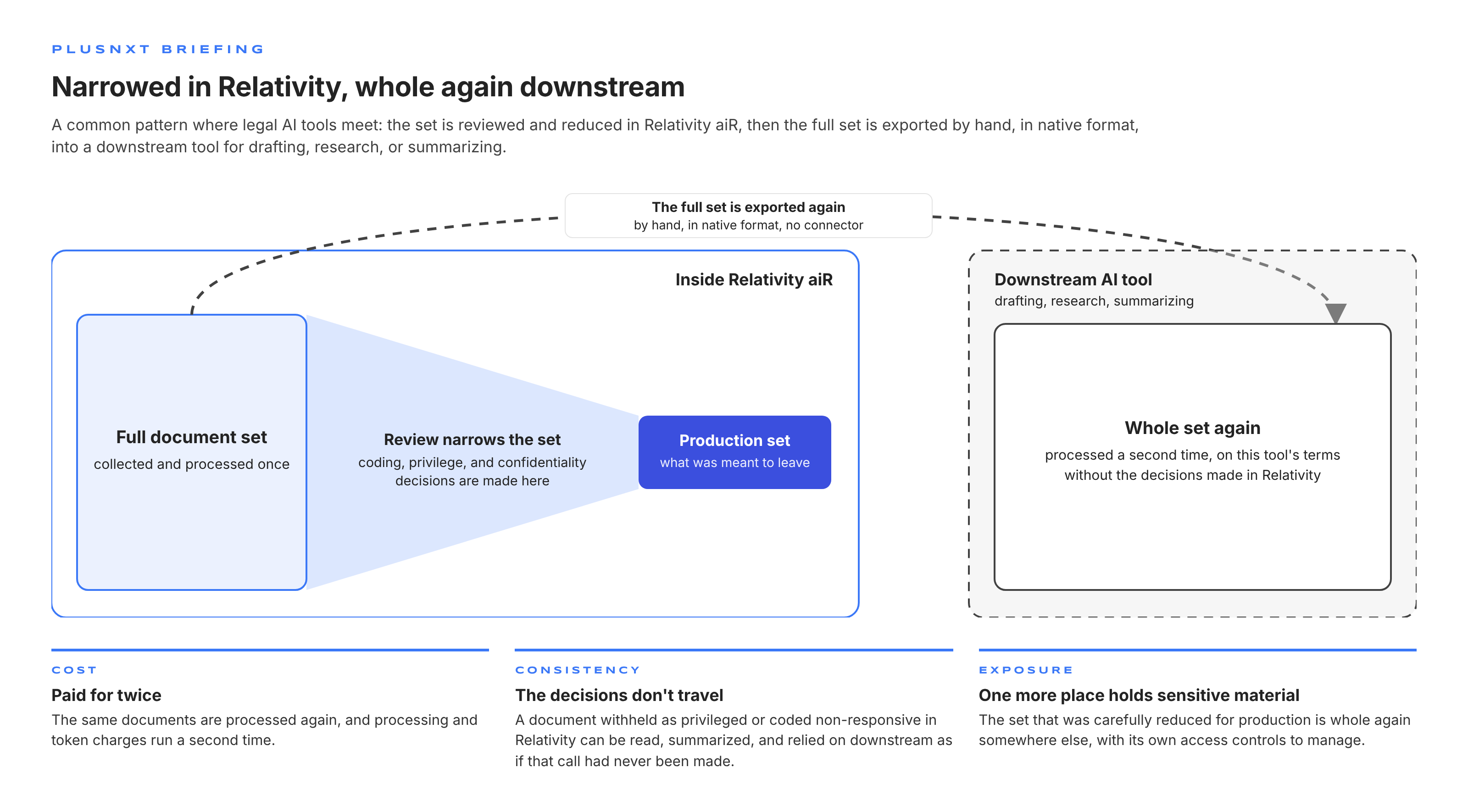
Each time matter data is copied out of aiR into another AI tool, three things follow: you pay to process the same documents twice, the same documents can be treated differently from one tool to the next, and sensitive material ends up in one more place. Those are decisions worth making before the matter starts: which tools will touch the data, in what order, and whether it has to move at all.
The Pattern: Narrowed in aiR, Whole Again Downstream
A pattern is becoming common where legal AI tools meet. A document set gets reviewed and narrowed in aiR. Then the full set is exported and reloaded, in native format, into a downstream tool for drafting, research, or summarizing. Most of these systems have no built-in connector between them, so the transfer is done by hand. The data is duplicated along the way, and processing and token costs get paid twice.
The Decisions Don't Travel With the Data
Just as important, the same documents can be treated differently at different points in the matter. Each tool processes, extracts text from, deduplicates, and analyzes the data on its own terms. The coding, privilege, and confidentiality decisions made in aiR generally don’t travel with an export, so a document withheld as privileged or coded non-responsive in aiR can be read, summarized, and relied on downstream as if that decision had never been made. Once data is copied into separate applications, there’s no single record of how each document was treated, and reconciling the differences becomes a manual exercise after the fact.
The set that was carefully reduced for production is whole again somewhere else, and one more place now holds sensitive material.
The Stack Is Growing Fast
The more tools in the stack, the bigger that problem gets. On May 12, Anthropic released Claude for Legal, with more than 20 connectors to legal platforms including Relativity, Everlaw, iManage, NetDocuments, and Thomson Reuters, plus 12 practice-area plugins. Thomson Reuters has rebuilt CoCounsel on Claude (LawSites, May 12).
Harvey, Legora, and Microsoft Copilot are in active use at firms and legal departments for drafting, research, and summarizing, and many of those organizations already hold enterprise agreements with the model providers. As Bob Ambrogi put it in LawSites, the foundation models now both underpin the legal applications and increasingly compete with them.
Inside aiR, Outside AI Comes in Through the Front Door
Relativity is building its own AI into the platform, with aiR and Relativity claiR at the center, and is connecting outside AI tools through MCP rather than through applications installed inside a workspace. It announced MCP integrations with Microsoft Copilot on August 31 and with ChatGPT Enterprise on September 17.. So far those connections handle administrative work: standing up matters, organizing workspaces, managing access, and running reports. Relativity says its substantive data analysis stays inside the platform (Relativity, August 31 and September 17).
That changes next year. Relativity’s president Chris Brown said in October that in 2027 the company plans to make matter-level data available through its MCP connector, so an authorized user working in a tool like Claude could query a matter the way they would inside aiR. In the same interview, CEO Phil Saunders said the company’s partnership priority “at this point” is the frontier model companies rather than legal AI vendors like Harvey and Legora, though he didn’t rule those out (LawSites, October 2). Today’s by-hand export is a problem you can see. If matter-level access arrives in 2027 as planned, whether the data has to move at all stops being an occasional decision and becomes part of every matter.
What It All Adds Up To
Taken together, these four developments say the same thing from different directions. Relativity has committed to AI. The courts have accepted validated AI review while punishing unverified output. The on-premises product can’t run that review and isn’t getting new features. And the companies behind the AI models now connect directly into the systems that hold matter data, with deeper access planned for 2027.
None of that requires a legal team to change anything this quarter. It does mean the questions worth asking about any new matter have changed: which tools will be used, how the output will be validated, and where the data will travel before the matter closes.
Sources
- RelativityOne Gets a New Name to Reflect Its Increasing Capabilities Around AI and Data, LawSites, September 16, 2026
- Relativity Expands AI Platform for Legal Data Intelligence with Conversational AI and No-Code Custom Document Analyses, eDiscovery Today, June 16, 2026
- Relativity Launches claiR, Relativity, August 12, 2026
- Court Greenlights Generative AI for Document Review, DLA Piper, July 2026
- Federal Magistrate Judge Treats LinkedIn's Relativity aiR Workflow as TAR, ComplexDiscovery, July 2026
- Whiting v. City of Athens, No. 25-5424 (6th Cir. Mar. 13, 2026), opinion via Justia
- Fake Cases, Real Sanctions: The Dangers of AI, ABA Litigation News, 2026
- Relativity Server Support Policy, Relativity
- Relativity Sets 2028 Deadline for All New Cases to Move to the Cloud, LawSites, January 2025
- Relativity CEO Says 2028 Server Deadline Stands; Will Prioritize Partnering with Frontier Labs Over Legal AI Companies, LawSites, October 2, 2026
- Anthropic Goes All In on Legal, Releasing More Than 20 Connectors and 12 Practice-Area Plugins for Claude, LawSites, May 12, 2026
- Relativity Brings Powerful Legal Data Intelligence to Microsoft Copilot, Relativity, August 31, 2026
- Relativity aiR Now Integrates with OpenAI Through the Model Context Protocol, Relativity, September 17, 2026


Want to hear more from PLUS?
Join our quarterly newsletter.